



Living in the Accomodation
 I Am in Strasbourg
Welcome to your new home!
In this section you'll find advice and information about:
- Furnishing your home;
- Maintaining your home;
- Recycling according to the selective sorting system;
- Living in harmony with your neighbours and avoiding noise pollution.


If it's not a Crous room or a furnished accommodation, you will have to get furnitures.
In Strasbourg and the surrounding towns, you'll find plenty of shops selling household goods. You should also consider recycling solutions (such as Emmaüs or the Vide Grenier Alsace).
Maintaining your home is necessary for your health and if you want to get your deposit back when you move out.
There are some simple things you can do:
- Open the windows for at least 15 minutes every day, even if it's cold;
- Recycle in the provided bins. Don't leave trash on the doorstep out of respect for your neighbours;
- Dust regularly;
- Clean up grease in the kitchen regularly;
- Clean and descale showers, baths, toilets and taps regularly;
- Wash floors;
- Clean the fridge regularly. Defrost it the day before you leave.
Respect common areas
The communal areas of a residence (entrance hall, bins, laundry room, lift, staircase, cycle park, etc.) are the responsibility of everyone who lives in the building.
It is important not to damage them and to look after them for everyone's comfort (don't leave your bins in the corridor or next to the bins provided for rubbish, pick up anything you drop in the hall, lift or corridor).
It's a sign of respect for the people who are in charge of maintaining these spaces.
Waste sorting is in effect in France. It is an environmentally friendly practice that involves sorting waste by type to facilitate recycling and reuse.
How to sort your waste?
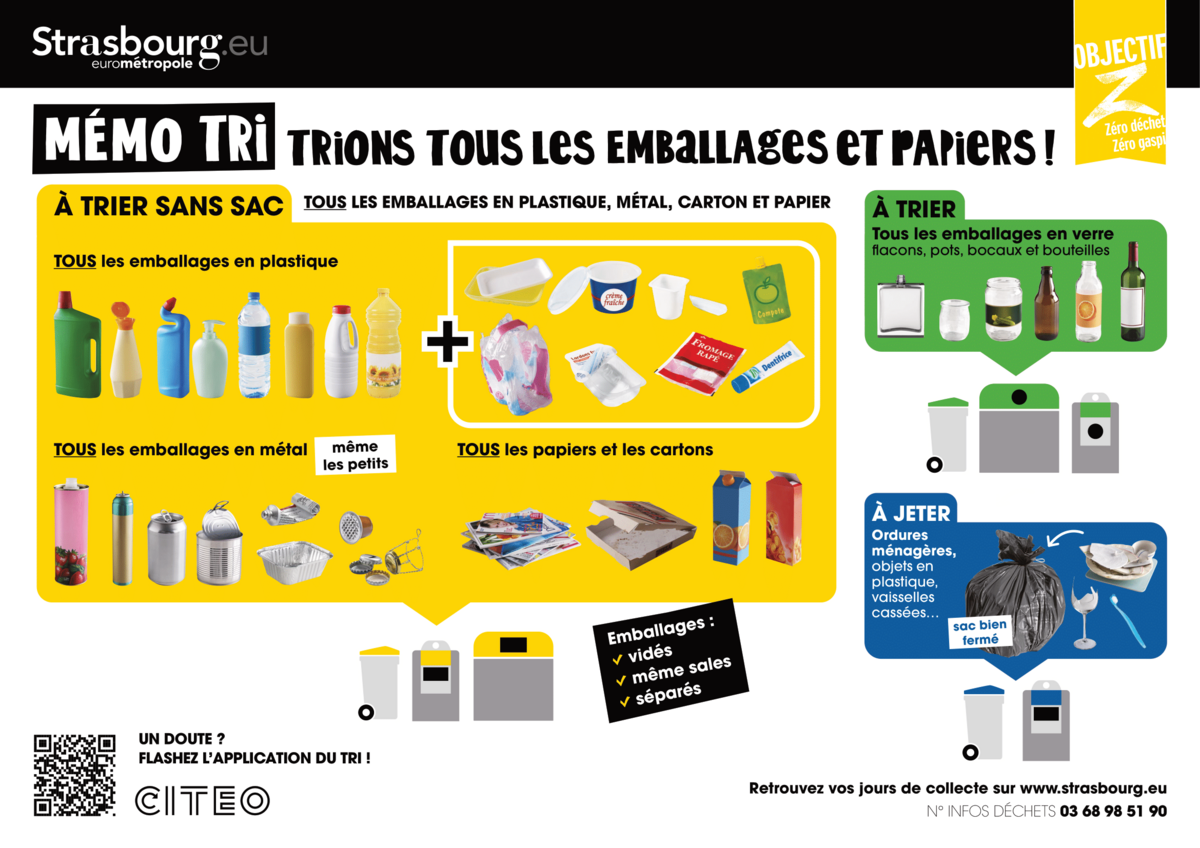
To sort your waste correctly, identify its type and put it in the right bin. The colour of the bins will help you find your way quickly:
Yellow bin:
- All plastic packaging
- All metal packaging, even the smallest items
- All paper and cardboard
Green bin:
- All glass packaging
Blue bin :
- Household waste in sealed bags
Not sure? Consult the sorting assistant from ADEME (French Environment and Energy Management Agency): What should I do with my items?
Where can I find voluntary drop-off points (PAV)?
Voluntary drop-off points (PAV) are containers where users can deposit their waste (glass, cardboard, sorted waste, textiles, household linen, and shoes).
Find your nearest PAV using the links below:
- Glass: see the map of PAVs for glass
- Cardboard: see the map of PAVs for cardboard
- Recycling: see the map of PAVs for recycling
- TLC (textiles, household linens, and shoes): see the map of PAVs for TLC
See also: https://refashion.fr/trouver-un-point-de-collecte for all the instructions on sorting clothing.
Towards zero waste
In the Eurometropolis of Strasbourg, you will find 100% bulk stores, composting points, as well as local repairers and even repair cafes to facilitate zero waste:
100% bulk stores in Strasbourg and the surrounding area:
- Le DaybyDay in Neudorf, BeeVrac in Cronenbourg,
- You can also find bulk goods in all organic stores (Côté Nature, Biocoop, Maison Vitale, etc.) – don't forget your containers!
Composting points:
Local repairers:
The Repair cafes:
- Map of Repair cafes in the Eurometropolis of Strasbourg.
Today in France, each inhabitant throws away an average of 71kg of food waste in their residual waste: that's 1/3 of the blue bin. Thanks to sorting, food waste is transformed into resources (natural fertilizer and renewable energy).
What kind of waste should be placed in the food waste collection bin?
All food waste such as peelings, eggshells, pits, leftovers (bones and meat scraps, cold cuts, fish bones, starchy foods, etc.) as well as expired products without packaging.
- Find all the collection points near you!
On Grande-Île, a bicycle collection service is available in the city center in addition to the food waste collection points.
A kit at your disposal
You can pick up a free compost bin and Kraft bags from official distribution points.
- The compost bin is perforated to limit odors and moisture. It is designed to stay in the kitchen and facilitate daily sorting.
- A set of compostable Kraft bags, usually distributed in packs of 50, can be replaced free of charge at distribution points.
You will need to provide proof of address (e.g., electricity or internet bill).
What happens to the collected waste?
The waste deposited in the bins is collected regularly. It is shredded and screened at the Valorest biodeconditioner at Port du Rhin in Strasbourg: this step removes any sorting errors such as packaging or cutlery.
At the end of this stage, the waste pulp is delivered to the Méthamusau methanization plant in Oberschaeffolsheim to be converted into biogas, which is injected into the natural gas network, and digestate, which is used by local farmers to fertilize their soil and crops.

This is the noise generated by activities in a dwelling (singing, moving furniture, piano, washing machine, etc.).
In general, everyone has to put up with a certain amount of noise, which is inherent to the neighbourhood and its environment. Only abnormal neighbourhood nuisance is punishable, i.e. noise that exceeds the limits of normal neighbourhood nuisance during the day (daytime nuisance from 7 a.m. to 10 p.m.) and at night (night-time nuisance from 10 p.m. to 7 a.m.).
If you are organising an activity that is louder than normal (party, DIY, etc.), warn your neighbours by posting a notice in the main corridors of the building indicating the event (date, time) and reduce noise after 10pm.